On the Butler Chain, the house and the dock are two separate builds.
Building here means a lake with its own permitting authority, a septic field on most lots, imported fill before a slab, and a dock that runs on a clock the house schedule does not control.
An acre, and the price is all about the water.
A dry acre out here traded between $450,000 and $900,000 last year. Put frontage on the Butler Chain in front of it and the same ground runs $1,400,000 to $3,600,000, because you are buying access to a connected run of lakes rather than a view of one.
Frontage width matters more than acreage: 118 feet of it, as on the Butler Chain house, sets what dock is permittable and how the house can face the water. Most lots here are on septic and many are on a well, which is fine and which takes yard space and an extra health department review. Assume site work at the top of the $18,000 to $60,000 range, because it usually is.
- The dock is not part of your house permitIt is a separate application, to a different authority, with its own drawings, its own biologist and its own queue. Five to nine months is normal. On the Butler Chain house it took seven and the family moved in before it was finished, which we told them in month two and which happened anyway.
- The shoreline is regulated groundThere are limits on clearing, on removing aquatic vegetation and on how close you can grade to the water. A view is achieved by selective trimming with a permit, not by a machine on a Saturday, and the fines for the second approach are the kind that get published in the paper.
- You are probably importing dirtBase flood elevation sets the finished floor, and on lower lakefront lots that means two to three feet of structural fill trucked in and compacted before anything is built. That is $25,000 to $70,000 that appears in site work, not in the price per square foot.
- Septic, well and a long service runNo sewer on most of these lots. A new system runs $18,000 to $27,000, the drainfield and its reserve take real yard, and power may have to be trenched three hundred feet from the road. Generators are standard here rather than a luxury, because so is losing power.
- The houses are bigger, so the schedule is longerNineteen months of construction on a 6,720 square foot house is not a delay, it is arithmetic. More trades, more coordination, deeper finishes and a boat dock running alongside it all. Sheet 04 has the phase by phase breakdown.
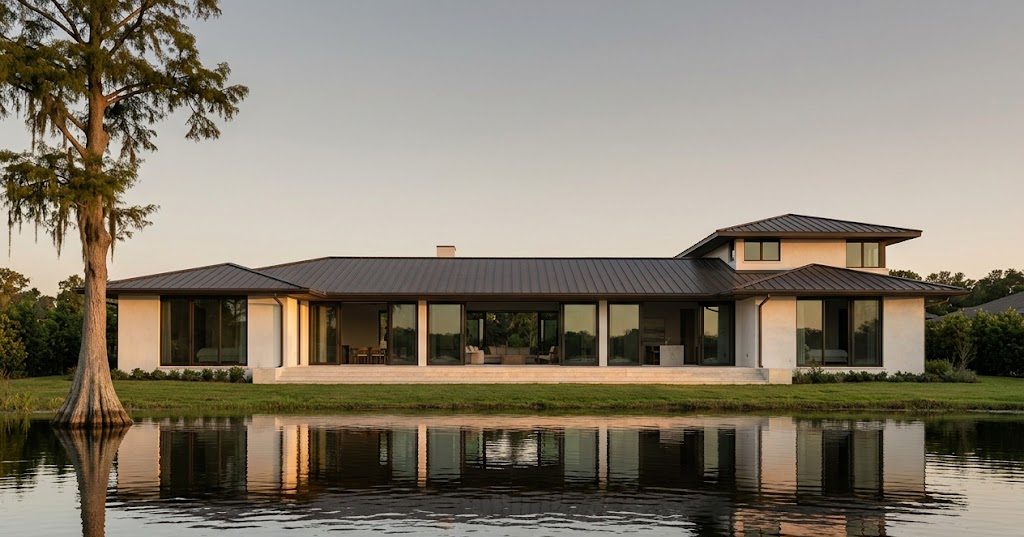
The Butler Chain house
The whole back of the house opens, which is the easy part to photograph and the hard part to build, because a 32 foot opening in a wind zone is an engineering problem before it is an architectural one. The dock arrived seven months after we started it and four weeks after they moved in.
The most expensive ground we work on, and the most site work.
The per foot number is higher because the houses are larger and the details are deeper. The number underneath it is higher because of fill, septic, service runs and a dock.
Three questions about Windermere.
How long does a dock permit take, and do you build it?
Five to nine months from application to a dock you can walk on, and we manage it rather than build it. The marine contractor is a specialist, the drawings are theirs, and we hold the schedule so the two projects do not collide. Start it the same week the house drawings start. Every family that waits until framing regrets it, and we have the one on sheet 17 to prove it.
Can I clear the shoreline so we can see the water?
Selectively, with a permit, and less than you are picturing. Aquatic vegetation and the first few feet of bank are protected, and the enforcement here has teeth. What actually produces the view is where the house sits and how high the finished floor is, both decided long before anybody looks at a shrub. We work that out at the site walk.
Do I need to raise the lot, and how would I know before buying?
An elevation certificate costs $500 to $900 and answers it in a week. It gives you the base flood elevation, the current grade and therefore how much fill stands between you and a finished floor. On the two lakefront lots we walked last year the answer was three feet on one and nothing at all on the other, and they were four hundred yards apart.